The Consequences
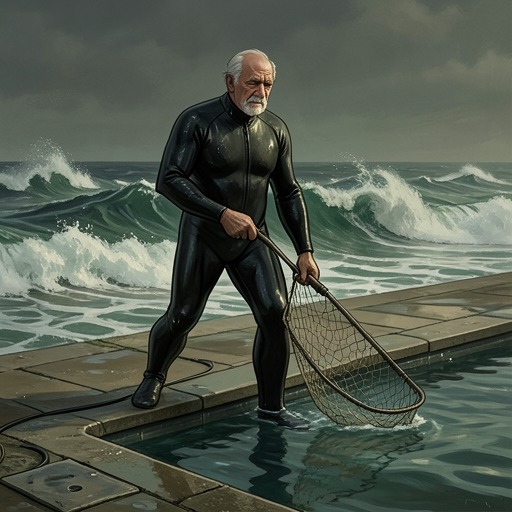
Remarkably Bright CreaturesThe Consequences is Marcellus’s name for the bodily crisis that overtakes him when he stays out of water too long. It turns escape into a timed negotiation: he can move beyond his tank, but must return before his body fails. As the effects begin arriving sooner with age, the phrase gathers a second meaning, marking not only the danger of each excursion but the narrowing time left to him.
Meaning and the eighteen-minute limit
Marcellus establishes the rule through observation rather than information supplied by the Sowell Bay Aquarium. The plaque beside his tank does not give the limit; he has determined for himself that he can survive for eighteen minutes out of water and must resubmerge within that span. The phrase names what happens when the clock runs out. It is his own practical vocabulary for a condition he has learned to anticipate, not a technical explanation of its cause.
The limit shapes every choice after he slips down the glass into the pump room. He can remain there, close to neighboring tanks, or force his way through the door and risk a longer journey. Food is available, but even eating has consequences for secrecy: Sea cucumbers are tempting, yet taking more than a few might draw Terry Bailey’s attention. The threshold therefore governs more than distance from water. It bears on how long Marcellus can explore, what he can take, and how much danger he can accept without exposing his nightly movements.
The escape that gives the phrase its force
An early excursion nearly turns the phrase from warning into death. When Marcellus returns, a stool has failed to keep the door open, and he must work to free it. By then, The Consequences are already in full effect. His limbs slow; his vision blurs; his mantle hangs heavily toward the floor, and his flesh pales to brownish gray. Crawling across the pump-room concrete, he can no longer register its temperature. His suckers fumble against the glass, and his tentacles become numb as he works himself through the opening into the tank.
For a moment, suspended partway between the opening and the water, Marcellus considers not returning. The bodily failure makes death an immediate possibility rather than an abstraction. But once submerged, his sight sharpens, color returns to his flesh, and his strength comes back; he replaces the pump housing and swims to his den. Relief follows the reversal. The episode teaches him not to trust a door held open by a stool, and he later says he never again relies on those extra minutes that such a prop seemed to offer. Other excursions still push the boundaries of his freedom, but the warning has become embodied knowledge.
A changing cost of freedom
The consequences recur, but they do not remain fixed. By the time Marcellus has been captive for 1,352 days, they arrive more quickly. He still gets past the rope Cameron has installed around the tank lid, but abandons food along the route to Terry Bailey’s office because he cannot afford the delay. A Pacific geoduck clam exhibit looks especially inviting; tonight, however, he has a different purpose, and his appetite is poor.
His errand is to retrieve Cameron’s driver’s license from Terry Bailey’s desk and hide it beneath the tail of a sea lion statue. Carrying the thin plastic card down the hallway, Marcellus feels terribly weak before reaching his destination. The return is slow and difficult, and he wonders whether the errand would have been worth dying for. That question gives the phrase a practical and emotional weight: The Consequences threaten not only a forager’s access to food but also the plans he chooses to risk his life to carry out.
The last escape
Late in Marcellus’s captivity, the limit has tightened further. Removing the pump housing has become more difficult, and he is already feeling The Consequences when he has worked only halfway through the gap. He states plainly that he does not have much time left. The phrase now points beyond the danger of a particular excursion: the brief interval he once learned to manage has become increasingly hard to use at all.
Even so, he enters the Wolf eels’ enclosure. His movement toward freedom remains an act of choice, but it is made under a steadily worsening constraint. When he is finally released, he initially sinks through the sea like an inert bundle, his arms no longer functioning. Then his limbs twitch awake. The brief return of movement does not reverse his decline: he knows death is imminent and expects, perhaps, a day or two in which to experience the sea’s vastness. The pattern established by the phrase persists in altered form—incapacity, a return of strength, and a narrow interval of life—but now recovery belongs to the ocean rather than to a return to captivity.
Narrative function
Capitalized as though it were a named condition, The Consequences gives Marcellus’s private bodily knowledge a memorable, repeatable form. Its first major appearance establishes a concrete sequence of symptoms and a means of recovery; later recurrences show that the same danger grows more immediate as his strength declines. The phrase makes the cost of captivity legible in minutes, failed movements, and postponed appetites, rather than in a general statement about confinement.
Its meaning changes with Marcellus’s circumstances. At first, the limit is an obstacle he can study and sometimes approach; later, its accelerated onset restricts even carefully planned journeys. At the end, his body’s weakness remains real, but freedom no longer depends on returning to the tank. The Consequences thus connects the small, repeated risks of his night escapes to the final, irreversible one: leaving the aquarium means accepting a life that may be short, but is no longer measured by an eighteen-minute return to captivity.